General Microphone FAQs
What is a microphone’s polar pattern?
A graphical representation of the directions from which a mic can capture sound from is known as its polar pattern. These take their names from the shape the pick-up area makes when plotted on a graph, showing a mic’s coverage when viewed from above. The most frequently encountered are cardioid (heart-shaped), figure of eight (front and back of the mic) and omni (where a mic can pick up sound from every direction).
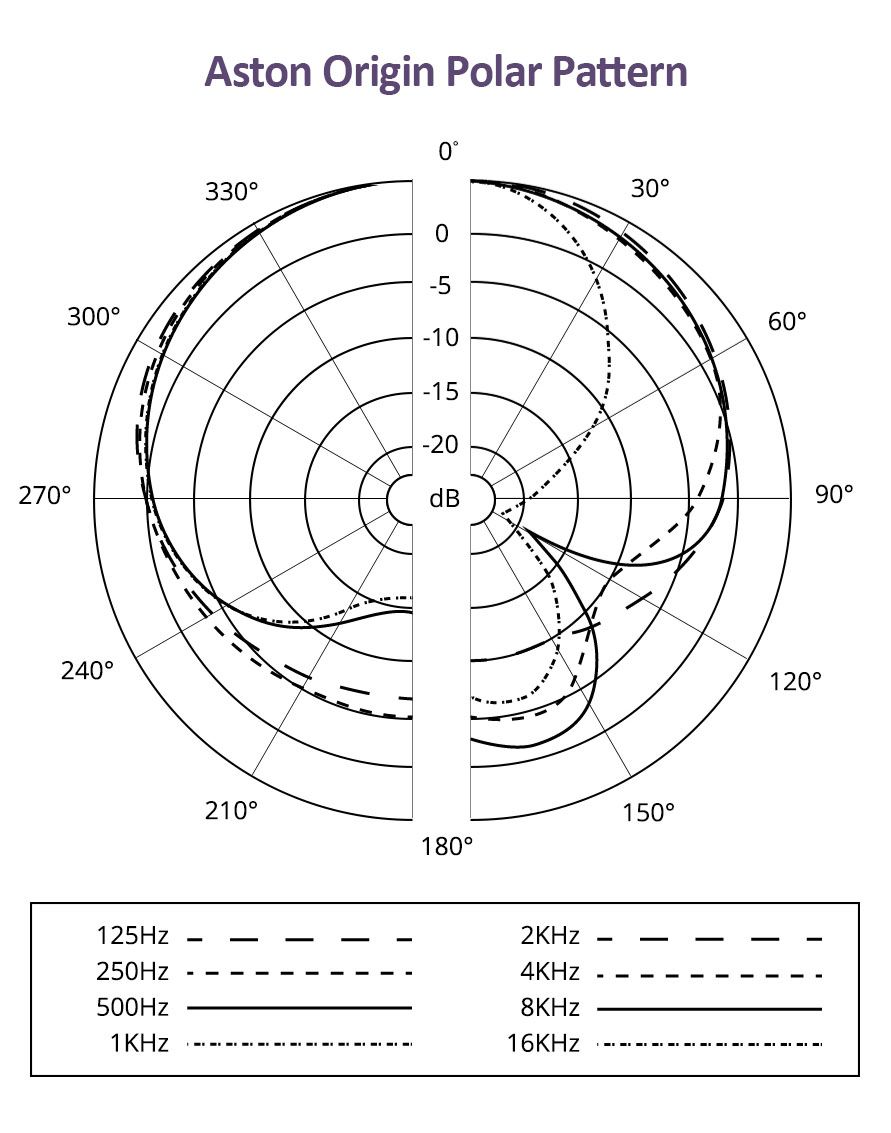
This example shows the cardioid pattern of the Aston Origin , with 0°, at the top, representing the front of the mic. The graph is plotted for a range of different frequencies and to avoid a cluttered diagram only the left or right half of each curve is shown – each would be symmetrical if fully displayed. The circles radiating from the centre show, in 5 decibel increments, the mic’s ability to capture sound in any given direction.
In practical terms this means a cardioid mic (like Origin, Element or Stealth) picks up sound mainly from the front (known as ‘on-axis’), less so from the sides (‘off axis’) and very little from the back. This focus on the sound source facing the mic makes cardioid the most widely used pattern for vocal recordings and for many solo instruments.
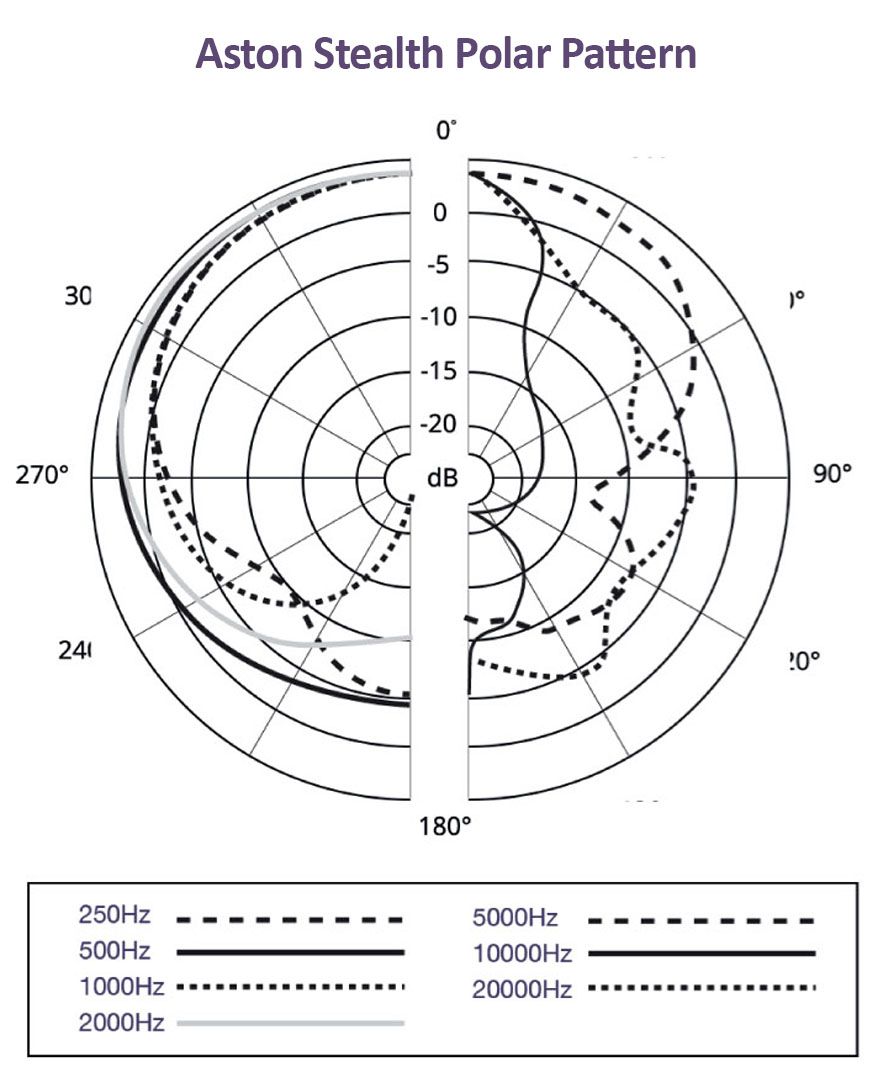
The more directional a mic is the less off-axis sound it collects (known as its ‘off-axis rejection’) and this can be useful for isolating a sound source without interference from the surroundings. Aston Stealth, for example, has excellent off-axis rejection, meaning it can produce great results even in less-than-ideal acoustic environments. As Stealth’s graph shows, this rejection is more pronounced on the higher frequencies (the higher the frequency the more directional the sound, which is why those bass notes get everywhere!).
The two mics should be stacked with their capsules as close together as possible, the cardioid mic facing the sound source and the figure-of-eight such that it is picking up sound from either side.
Although there are dedicated mid/side decoding solutions available you can achieve full control over the stereo recording in your DAW, so long as it has the ability to phase-reverse (all the major DAWs do). The recording from the cardioid mic should be panned centrally. Then the figure-of eight recording should be duplicated with the resulting pair panned hard left and right. Then you need to phase-reverse one of these (It’s a good idea to group the pair or send them to a bus so their levels can be changed simultaneously).
By combining the three channels you now have a stereo spread comprising centre + left and centre + right. The ‘secret sauce’ is that by changing the level of the two side channels in relation to the centre, you can now increase or decrease the stereo width of your recording to fit the needs of your mix. Cool huh?
Aston Spirit has selectable polar patterns, so in addition to cardioid, you can also choose figure of eight and omni.
Figure of eight captures sound evenly from the front and back of the mic, useful for recording two voices at once and also for stereo applications when using two mics (for example Mid/Side Stereo Recording).
Omni captures sound from all round the mic, great for a group of vocalists, as Jamie Cullum demonstrates in the video below. Omni is also useful for ambient recording, drums and for natural recordings in interior spaces.
What is phantom power?
Condenser and active moving coil microphones are two of the mic types that need 48v phantom power. Most good quality soundcards, interfaces and mixing consoles have the ability to send phantom power to a mic.
Phantom power is DC current sent to the mic via its XLR cable, which simultaneously sends its audio signal the other way. Because the XLR cable is balanced (three core) any unwanted noise is cancelled out and the audio signal stays free from interference.
All of Aston’s microphones to date require phantom power, with the exception of Stealth which can operate with or without. Origin, Spirit and Starlight are all condenser mics, Element and Stealth are moving coil mics with active electronics.
What is proximity effect in microphones?
Proximity effect manifests itself as an increase in low frequency response when a sound source moves close-up to a microphone. How pronounced this boost is varies between mics depending on their design and polar pattern. It is noticeable on most cardioid microphones when, for example, a singer gets within a few inches of the capsule (Omni-directional mics have no proximity effect due to their transducer type).
Like many facets of a microphone’s performance, proximity effect may or may not be a good thing, depending on the desired result. The more low-frequency content in the sound source, the more pronounced the effect so, for example, when recording a guitar cab close-mic’ing can give a fuller, ‘beefier’ sound, or could equally cause an overly boomy sound. Similarly with vocals, proximity effect can add to the grit and gravel of a voice and add depth and warmth, or could be overbearing and boxy-sounding.
It’s best, as ever, to use your ears to judge – but watch that input meter, as the levels will go up as the mic goes closer to the source.